2024:All about bookmakers

Tuesday, April 2, 2024

Betting on late goals

 For example in relation to late goals betting, look for games with a clear favourite with 3-way winning odds of less than 1.30. In a betting round, spread the risk over as many games as possible; obviously, there will always be some unexpected losses. Then, bet on late goals for each of these games. Most bookmakers offer these bets under the name “Last goal will be in minutes 76-90”. Statistically, you will win just under 60% of all of these bets.

It is also important to note that you only ever play single bets. With a combination, no matter how temptingly high value it might have, your chance of winning drops drastically.


What’s a Money Race?

 A money race is a betting strategy in which the profit amount from a winning bet is invested directly in the next bet. This is usually continued through numerous bets until a desired amount of money is reached.

How do you play Money Race?

The Money Race can be run with all possible types of bets. In most cases, however, the focus is specifically on low odds and thus “safe bets”, in order to win as many bets as possible in a row. In this case, the Money Race is particularly interesting for sports bettors with a high bankroll. If the Money Race is started with a rather high initial stake, you will save yourself numerous necessary profits on the way to the self-imposed goal. At the same time, however, the risk of loss is also greater.

If you decide to start a Money Race with 20 € and always bet on events with odds 1.20, you need 22 consecutive wins to get over 1,000 €. However, if you start with a stake of 100 €, after 13 bets you have won with odds of 1.20, you will exceed the 1,000 € mark. This is shown in this calculation example:

  • 20 € x 1.2 x 1.2 x 1.2 x 1.2 x 1.2 x 1.2 x 1.2 x 1.2 x 1.2 x 1.2 x 1.2 x 1.2 x 1.2 x 1.2 x 1.2 x 1.2 x 1.2 x 1.2 x 1.2 x 1.2 x 1.2 x 1.2 = 1,104.12 €
  • 100 € x 1.2 x 1.2 x 1.2 x 1.2 x 1.2 x 1.2 x 1.2 x 1.2 x 1.2 x 1.2 x 1.2 x 1.2 x 1.2 = 1,069.93 €

With the help of higher odds, a Money Race can of course also be accelerated, but the risk of losing all winnings is significantly higher. Usually you vary your bet a bit; after all, it is also very important with the Money Race to avoid going wild, but to research well instead despite the low odds. As with all bets, it is important to bet when you are certain that the outcome is highly probable. Even if you are strongly focused on an average odd, in our example the rate 1.20, it is not a problem if there is a 1.40 or 1.50 in between. Here, too, research and conviction is of outmost importance.


Bet live on over 1.5 goals

 With this betting strategy, you are betting on live games on the bet type “Over 1.5 goals”.

The “live over 1.5 goals” betting strategy

Live betting on “over 1.5 goals” is a very lucrative betting strategy. This bet has an interesting advantage due to the development of the odds. First of all, you should do the same thing as with normal over / under bets. Find a game where you expect an over 2.5. Only use this betting strategy for bets where you expect this.

Before the game, the odds of an over 1.5 will be very low. In some cases, it is no higher than 1.20. But while the game is running and the goals are missing, this rate increases almost every minute and becomes more and more lucrative. Now you have to be patient. Ideally – as with any bet – you should watch the game live at the same time in order to have the greatest possible advantage.

Now wait until the bet has odds between 1.50 and 2.00. The higher the better, but of course the timing is important. If a goal is scored, the bet is over before it has even started and you have to find a new game. This strategy only works if it is 0-0 long enough. Usually, you will have to wait until the 35th to 55th minute so that the odds on the over 1.5 are fair. However, we recommend that you still bet in the first half – it is important that the odds are 1.50 or higher.

You analyzed the game before kick-off and expected an over 2.5. If you’re not completely wrong, goals will still be scored here. And we are eagerly awaiting the first goal as soon as the bet is played.

If a goal is scored quite early after your bet, then you have – at least with most bookmakers who allow this – a profitable exit strategy: The odds for the over 1.5 will of course rattle off after the first goal. Now you can have the bet paid out via cashout, you can virtually “sell” it. You will definitely get out with a plus.

The riskier option is to wait for the second goal and win the bet anyway. Here it is of course advisable to watch the game live. If there is a goal in the air, you can still wait and let the bet stand. If the game is a tense affair, then it may be better to sell the bet.

In any case, for such a strategy it is advisable to bet with a betting company that allows a live cashout option. For more information on the subject of live betting, see also the live betting section of our page.


Dutching in sports betting

 Dutching is the process of betting on more than one selection during the same event, so that no matter which selection wins, a profit can be made. This should not be confused with arbitrage, which involves betting on all possible outcomes of an event, so that a guaranteed profit is generated. This is only possible by using several bookmakers and only for a few events.

Dutching is ideal for multi-outcome events where you think you can break the possible outcomes down to two or three; but in theory, you can bet on any number of selections. The fewer selections you make in dutching, the fewer losers you support and the more profit you make from them. However, by dutching fewer selections, you increase your risk.

Dutching is best used when you either have information or have a very strong feeling that an outcome is very unlikely. If those unlikely outcomes have huge odds, then dutching is not worthwhile, but if you think the desired outcome is unlikely, then the remaining selections in dutching pay good dividends.

Determination of the different stakes in dutching

The main characteristic of Dutching is that you win the same amount, but with all the different odds involved, it can sometimes be difficult to figure out the stakes required.

Example:

If you cover two selections, one with 5/1 and one with 8/1 and you want to win 100 € regardless of the outcome:

Divide the odds in decimals (6.0 and 9.0) and divide the stake by the decimal odds.

100 € / 6.0 = 16.66 €
100 € / 9.0 = 11.11 €
Total stake = 27.77 €

Alternatively, you might have an idea of how much you want to bet on an event; in this case it’s around 30 €. You know that your stake on the 0.6 chance is around 20 €. To calculate how much you should bet on the other selection:

20 € x (6.0 / 9.0) = Bet on the higher valued selection. = 13.33 €

The total stake would then be 33.33 € and if one of the two selections wins you will receive 120 €

Calculate combined odds in dutching

In dutching, it is important that the selections you are betting on have combined odds. To pick the best bets, you still need to consider odds and choose events where your combined selections have the best chance of winning in relation to your odds, rather than simply supporting all of the selections you think might win.

Example:

If you bet a total of 100 € and the return on a winning bet is 150 €, then you cover all of your selections with combined odds of 1/2 or 1.5 as a decimal number.

When placing your Dutch bet, you have already worked out your stakes and total returns so that you can place the bet, with the same return for each outcome. To get the decimal odds for your bet, you simply divide your total stake by your returns.

It may seem difficult to estimate the combined odds when the numbers are a little more random, such as 279 € win for 82 € stake, but it is very easy to figure out:

279 € / 82 € = odds of 3.4, which is roughly 5/2.

Advantages of dutching

  • Offers new possibilities

One of the greatest advantages of dutching is that it creates new opportunities for profit. In the past you may have broken a race down to two horses, but it wasn’t easy to choose these two horses and so you left the race. Alternatively, you might have guessed that a soccer game would end with very few goals, but you weren’t sure whether you should bet on 0-0 or 1-0. With dutching, you can get paid off for both of these situations.

  • Still getting value

Just because you’re betting more than one outcome, this doesn’t mean you won’t get any value from your bet. If you think a low-rated favourite is very unlikely to win, then two or more high-rated selections in this event could offer great value. If the added up returns from the combined bet are greater than the chance that those outcomes will win, you will generate value through dutching.

  • More winning bets

By dutching you reduce your overall odds, but increase your chances of winning your bet. In theory, this should result in more winning bets and therefore more frequent betting returns. This helps to protect your betting account from dry spells and should also offer you some joy in betting.

Disadvantages of dutching

  • Weakening of profit

The more selections you make in dutching, the more you reduce your overall odds in each betting event. Whenever you decide to add new selections, you have to take into account the fact that your betting rate needs to improve, so that a certain level of profit can be maintained. If you use dutching and don’t win very often, you will lose your money very quickly.

  • Reverse dutching

Reverse dutching sounds complicated, but it’s just dutching for trade. The same principles apply; the more choices you make, the more likely your bet will win, but the less money you will win. And on the contrary, the fewer selections you make, the less likely it is to win and the more profitable any winning bet is.


The Kelly formula

 There are of course numerous ideas, concepts and formulas that can help you calculate the ideal stake on a bet. One of them is the Kelly formula.

Of course, this is no guarantee that you will always bet correctly and the assessment of how likely the outcome of a game is, does still remain up to you. But the Kelly formula can help you choose the size of your bet.

This is how the Kelly formula works

  1. You choose a game or an event and rate the outcome as a percentage
    Example: Austria defeats Germany – you rate this outcome with a probability of 20%
  2. Now, you are looking for an odd for this event that seems fair to you
  3. Then, you put the probability and the odds in the Kelly formula and get a value from it

Let us take as an example the 20% probability of winning with odds of @ 5.50.
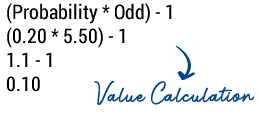
First we do the math, where the probability of 100% is 1:

Kelly value calculation sportsbetting
Value calculation after Kelly

Now we can continue to calculate and find the best possible stake for this bet. The formula used to choose a reasonable stake looks like this:

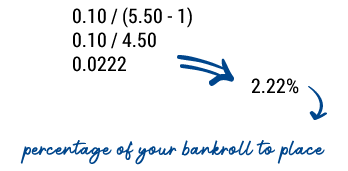
Percentage of bankroll to be set = value / (odds – 1)

In our case this means:

Kelly bankroll calculation sportsbetting
Bankroll calculation after Kelly

The Kelly Formula hereby recommends that, given the probability that you have determined yourself and the odds you have chosen, you should bet 2.22% of your bankroll on this event.

Now, of course, the use of this formula also depends heavily on your assessment of the probability. And if you consider a game outcome to be very likely and thus increase the value considerably, then it can happen that you get 30% or even more of your bankroll as a result. Of course, caution is advised here because your bankroll can slide down very quickly this way.

It is also possible that you will get a negative result when calculating the first value. This happens if you bet too low with an expected probability of winning on an event with too low odds. The result is that your value is negative, which means nothing else than: if you are unsure about this, then this bet just doesn’t pay off …


The Fibonacci betting system

 The Fibonacci betting system is one of many betting strategies available today. Here we explain what it is all about.

The Fibonacci betting strategy

Fibonacci sequence betting is undoubtedly a controversial concept. But there are definitely sports bettors who were able to achieve great success with it. This strategy carries some risks, but with the necessary luck and the right nose, you can be successful while employing this strategy.

The basic concept of betting according to the Fibonacci sequence is simple: bet on a tie. If you lose, just bet on the next tie according to a certain key and start increasing your stake.

It is important that the odds for the tie are above 2.62 (more precisely: 2.618); luckily for those who want to employ this strategy, there are many tie bets for this minimum odds. The higher the rate, the better.

Fibonacci Betting Strategy
Betting after Fibonacci

If you lose, you simply bet the next tie after a Fibonacci sequence. It is a sequence of numbers in which the sum of two consecutive numbers results in the next number, making the Fibonacci sequence an infinite sequence of natural numbers. You can find more information about the Fibonacci sequence on Wikipedia.

Fibonacci numbers
The Fibonacci sequence

So if you start betting with 1 € on the first draw with odds> 2.62 and lose, then the next time you bet 1 € again, then 2 €, then 3 €, then 5 €, then 8 €, then 13 € and so on.

It is mathematically understandable that every profit that you will achieve with this bet will offset the previous losses and you will even make a net profit.

An example of the Fibonacci bet

Let’s take the example of the situation where you lose ten times in a row and win your bet the eleventh time. In this case, you have already gambled away 143 € and finally successfully placed the eleventh number in the Fibonacci sequence, 144, on a bet. If we now assume that the successful bet had odds of @ 2.80, you win 403.20 €. You have wagered a total of 287 €, making your net profit 116.20 €.

The disadvantage of this strategy is also obvious. Assuming you lose not ten bets in a row, but twenty, then you would have already lost 16,910 € in stakes. This is a huge bankroll, which you should of course never risk for such a betting sequence. You can find more about this in our explanations on bankroll management.

The Fibonacci betting system – our conclusion

When betting according to the Fibonacci sequence, you depend on timely success. Otherwise, you will eventually no longer be able to afford the stakes and you will lose a lot of money. Of course, this strategy can also work well. For example, you can focus on a specific team that is known to draw often. But purely based on the theory of probability, one day you will surely get into a stage that you can no longer manage financially.


The 1-3-2-6 system

 The 1-3-2-6 system is similar to another positive progression betting system known as a Paroli. Both involve increased stakes after a win, and both involve a cycle of bets ending at a fixed point. The only real difference is the actual betting sequence.

There are not many systems that are easier to understand than 1-3-2-6 and its simplicity is very appealing to many players. There are also a number of other benefits that contribute to its popularity.

Of course, as in any betting system, there are also disadvantages. We explore the positive and negative aspects of the 1-3-2-6 below, along with the details and how it is used.

Use of the 1-3-2-6 system

Like many betting systems, the 1-3-2-6 was designed for bets that pay out an even sum, like the red-black bets in roulette. In fact, it is widely used on the roulette table and in other casino games such as baccarat, dice games and blackjack. Basically, it doesn’t matter what you use it for, provided you are playing with even sums.

As mentioned earlier, this is a very simple system. All you have to do is adjust your bets based on a few simple rules. First of all, you have to decide how high your betting unit should be. As a guide, once you’ve set the amount you’re willing to lose in one session, your betting unit should be around 2% to 5% of that.

For example, if you wanted to play with a total of 500 €, 10 € would be a reasonable number. A bet unit is the amount you wager on the first bet in the sequence. After every lost bet, the sequence ends and you start a new one – and again you insert a betting unit.

If you win a bet, you adjust your stake according to the sequence 1-3-2-6. So, if you win your first bet, the next time you increase your stake to € 30 (three betting units). If you win this too, you will place € 20 on your next bet. If you win this too, the next time you wager € 60. And already we have the 1-3-2-6 sequence.

If you win the fourth, consecutive bet then the sequence is completed and you start all over again. Don’t forget, as soon as you lose, your stake will also reset to a betting unit.

This is basically what the 1-3-2-6 betting system is all about. As long as you keep the simple set of rules in mind, you shouldn’t have any problems using this system successfully.

Possible outcomes of 1-3-2-6

Since this system is only a short cycle, there are few possible outcomes. These are the following:

  • Loss of the first bet (total loss of one betting unit)
  • First bet won, second bet lost (total loss of two betting units)
  • First two bets won, third bet lost (total win of two betting units)
  • Won the first three bets, lose the fourth bet (breakeven)
  • Win all four bets (total win of 12 units)

So, as you can see, only two of the possible outcomes of a cycle involve loss. A loss will only occur if the first or second bet is lost. So, every time you win the first two bets, you cannot lose again in the same cycle.

It may seem like the 1-3-2-6 system makes it more likely to make money than to lose. But unfortunately, this is not true. Unfortunately, while the system has some advantages, the guaranteed profit isn’t one.

Advantages and disadvantages of the 1-3-2-6 betting strategy

Perhaps the greatest advantage of 1-3-2-6 is that it is very simple and easy to learn. If you want to use a betting system that you don’t want to be overly complicated, this is a good option. In addition, your stake is not increased after a loss – this prevents the rapid loss of money, especially if you choose the size of your betting units sensitively.

Another notable advantage is that after stopping the sequence after four consecutive wins and then going back to one unit, you are facing the possibility of a small winning streak. There is a chance that you will win all four times in a row – and if you are lucky, your winnings will exceed the losses on bets you lost before.

The system does not come without its disadvantages; the most striking is that there is nothing to beat the house edge that exists in any casino. No betting system can do this. But it helps you to maintain discipline with a set of rules to be followed, because ultimately you still have to rely on your luck to win. If you get the wrong sequence of results, you will lose.

The 1-3-2-6 isn’t a bad betting system compared to any of the other systems available, provided you accept it for what it is. This system doesn’t guarantee that you will win, but it can help you get the most out of your luck.

All-in on odds at 1.20 strategy

 This betting strategy involves winning numerous bets one after the other and always using the maximum offers the opportunity to earn decent money. But it is also clear that all the money is gone if you lose a bet. But if you manage to win 30, 35, maybe even 40 times in a row, you’ll get big money!

We use odds around 1.20 for this – ideally you should look for the bets you are playing live. As with the strategy of betting over 1.5 goals in what is estimated to be typical “over” games, you can wait here until the odds have reached the desired level. The over 0.5 bet is ideal here – i.e. the bet that the game will not end 0-0. Usually, after goalless 30 minutes, you get a rate of 1.20 – depending on the match, this can of course be lower, but sometimes even higher. Of course, it is a matter of taste with which type of bet you want to monetize your betting sequence, or money race‘ as it is also called.

It is important that you always play roughly the same odds. This is certainly a test of patience and not particularly spectacular at first, but there is no exact goal and you can stop at any time and have your winnings paid out. For example, if you start such a series of bets with a stake of 10 €, that’s all you can lose. So you now find a bet with odds 1.20, win it and immediately play the 12 € you won again on odds that are around this amount. You win 14.40 € – which will be invested in the next bet.

The profits will only become noticeable very slowly, but will increase sharply over time, because of course the stake grows higher and higher. If you actually manage to get 30 picks right in a row, your 10 € from the beginning will already be a whopping 2,373.76 €. After 35 correct pick we would already be at 5,906.68 € and after 40 correct picks at 14,697.71 €.

Of course, it is far from likely to have so many tips in a row right – but this progressive betting strategy is also something for the thrill. If you do not start the betting sequence with too high a stake, you cannot lose much and there is of course the possibility of starting a real streak when employing this betting strategy.


1X on home outsiders strategy

 A betting strategy that has been successful in the past is the bet on the “double chance” 1X if an outsider plays against a favorite at home. In this case, the “1X” bet brings respectable odds and very interesting profit opportunities.

Home win or draw betting strategy

You don’t even have to choose and analyze games that contain absolute extremes and obvious class differences with this strategy. So, you don’t necessarily have to bet against Barcelona, Bayern or Juventus as an away team. Here, we would probably move away from the value bets. Even if we opt for teams that are not big outsiders, but are still outsiders according to the odds, we find highly interesting odds between 1.60 and 2.50.

As with all bets, it is important to analyze in advance and not blindly going for any team. You should of course take statistics into account, advance information about injuries and suspensions, as well as the current shape of the teams. The home advantage of the outsider, for whom games in front of their own audience against a “bigger one” also represent a special motivation, should not be underestimated as it brings another small advantage for the home team. Especially when the respective favorite has recently shown itself shaky against “smaller ones”, you can definitely find value in such an outsider bet with double chances.


Thursday, March 7, 2024

Win-win strategy for sure bets

 The arb strategy is the only strategy that guarantees the player a profit, no matter the result, however, it is extremely difficult to find bets for it. To do this, you will have to look at the lines of several companies and look for inflated odds.


How does the arb strategy work? Let's look at an example.


For the match between Atlético and Elche, one of the bookmakers offers to bet on TB 2.5 with odds of 2.05. And at another bookmaker you will find a bet on TM 2.5 with quotes of 2.10. If you bet the same amount, you will be in the black anyway.


Of course, you won’t see such freebies for top matches. To find overvalued odds, you need to go to unpopular championships (Qatar, South Africa, Finland) or to the lower leagues. Value bets for arbs are also found in exotic sports (floorball, darts, cricket).

Corner kick betting strategy

 Among football bets, outcomes with corner kicks are not very popular, but professionals often look towards such an outcome. Place a bet on the favorite of the match with a minus handicap (-2 or -3 would be a good decision). But you can place a bet only if the following criteria are met:


The favorite team plays at its home stadium.

The team prefers to play through crosses from the flanks and does not strongly adhere to combination football.

Among the attackers there is a pillar (a tall forward who can force a fight for the ball).

The outsider team sets up a bus at its gate and has little to offer in attack.

Football total betting strategy

 The essence of the strategy is to bet on a total greater than 2.5. One of the most popular bets in bookmakers. It is recommended to place a bet when the match meets the following criteria:


The match is played by two teams playing in an attacking style of play.

The teams' best scorers are on the roster, and the physical condition of the goalscorers is not a cause for concern.

Each of the opponents has high tournament motivation - a draw result will not suit the teams.

In past games involving these teams, TB 2.5 was shot at least 70% of the time.

Opponents produce productive matches during the season.

D'Alembert and Flat betting strategy in football

 With flat everything is as simple as possible. The strategy involves a fixed amount for each bet, regardless of the quotes and your bankroll. For example, you decide to bet $3 on each bet. The result needs to be looked at over distances - professionals evaluate the effectiveness of flats after 100-200 matches.

The d'Alembert betting strategy is based on the law of equilibrium of the French scientist Jean D'Alembert. You make an initial bet and then determine the increment. After a loss, the bet amount increases, and after a win, it decreases. For example, you bet $10 and the increment is $5. Lost? Bet $15. Did you win? Bet $10 again, etc.

Oscar Grind Strategy

 Oscar Grind is a famous American betting player, but instead of sports, he preferred casinos, and even developed his own strategy. The basis was the usual theory of probability. The capper takes two equally likely outcomes and bets on them. Now let's look at the essence of this strategy.

First you need to set a goal as a percentage of your bankroll. Let's say you have $100 and you would like to make a 5 percent profit ($5) in one cycle. In case of loss, the bet does not change, but winnings double it. We select outcomes with quotes starting from 2.00.

For example, you bet $5 with odds of 2.00. If you win, you receive a profit of $5, which means the cycle is completed.

If you lose, make a second bet of $5 with odds of 2.00. Another loss? We repeat the action. After winning, we bet 10 dollars. A win will close the cycle.

For a strategy to work, it is important to choose equally likely outcomes. A great example: betting on an even and odd number of goals. Although minimal analytics still won’t hurt.

Betting strategy on a draw

 The essence of the strategy is simple and clear - you need to choose a match of equal strength opponents. In pre-match situations, a draw is usually estimated at 3.00-3.50, so even on a flat (bet with the same amount, over a distance) you can make a good profit. It is reasonable to bet on a draw in the following situation:


There are many draws in the tournament.

A draw would be a satisfactory result for each opponent.

In personal meetings between teams, a draw has often been recorded in the last 3-5 years.

In the results statistics, teams often end matches in a draw (based on the results of 5-10 rounds).

Betting strategy for late goals

 The essence of the strategy is that the player predicts that a goal will be scored after the 75th minute of the match. In live, you can wait until the 80th minute for the odds to increase to 2.00 or higher. You can place a bet when the match meets the following criteria:

There are many chances in the match, both at one and the other goal.

One of the teams does not have a clear advantage in the score.

The coach refreshed the squad and released fast forwards.

The most predicted total by bookmakers did not play in the game.

In addition, there are teams that consistently score in the last minutes. Let's remember the famous "Fergie Time" at Manchester United.

Betting strategy for catching up

 Dogon is the most popular sports strategy, suitable for any sports discipline. The idea is as simple as possible - with each unsuccessful bet, you increase the amount of the next bet in order to win back all your losses with one bet.

The classic catch-up, called the Martingale strategy, requires the player to double each subsequent bet - $2, $4, $8, etc. And the outcome odds must be at least 2.00.

The strategy can be modified. For example, you place the next bet with odds of 3.40 (the outcome seemed passable to you, based on the analytics performed). There is no need to double the bet. There is even a special formula for calculation:

C = (CB + SP) / (K-1), where C is the bet amount, CB is the amount of the planned winnings from the first bet, SP is the sum of all losses, and K is the odds of the event on which you are betting

Betting strategy on total goals in the first half

 This strategy involves a match where teams are not going to play defensively. The second game of the playoff stage is suitable, when it is important for one of the teams to win back the advantage, so there is no time to build up. If the odds for a total of more than one goal are above 1.50, place a bet with this outcome. You can take a risk and bet on TB 1.5 - quotes are usually above 2.00. A good life hack: place a bet live. Total odds will increase in real time, and in 5-10 starting minutes you will understand whether the teams have the potential to make the first half productive or not. Place a bet only when the score remains 0:0.

Double Chance Betting Strategy

 “Double chance” is a popular outcome when a player insures himself by choosing two out of three outcomes at once. Bookmakers offer three double chance options:


1X – home win or draw;

12 – victory of the hosts or guests (a draw is excluded);

X2 – guest victory or draw.

The winning bet will be with any of the options. For example, you bet on the result 1X - both the victory of the first team and the draw make your bet equally winning.


In what cases is it recommended to bet on double chance?


You predict the favorite to win, but you are not 100 percent confident in the team. If the odds for his victory are above 1.95, then a double chance can be placed at 1.30-1.50.

Choose a match where the favorite is strong but is in significant trouble. For example, there are a lot of injuries in the team or the team plays too many matches in a short period of time. Place a double chance bet on the underdog. Quotes sometimes exceed 2.50-3.00.

Look at a match where neither team is satisfied with a draw, and place a bet on the “12” option, which excludes a draw.

Betting strategy Fibonacci system

 If a player really manages to bet on options with odds of 3, he can use the Fibonacci system. This is a soft catch-up when rates increase in the following sequence:

1, 1, 2, 3, 5, 8, 13, 21, 34

It is easy to see that the size of each bet is equal to the sum of the previous two. That is, after each loss, the size of the next bet is equal to the sum of the previous two. The first rate is 1% of the current bank. The following are also defined as interest from the bank.

It is easy to see that the bettor has 9 consecutive attempts in stock. If he loses them, then 12% of the bank remains. And it is also important that with each step the potential profit increases. That is, it turns out not only to win back, but also to earn more than in the first steps. These football bets (strategies) provide good chances for confident growth of the bank.

Flat bets

 You can use a standard flat, when for each operation with odds from 2 to 3, the bettor allocates from 4% to 5% of the current bank. The player’s main goal is to confidently pass the break-even point and gain profit. To earn 20% on bets with odds of 2.5, a person must win 48% of the bet. And even if these are not win-win football betting strategies, flat bets are quite reliable.

Please note that it is often possible to catch large odds in live games. And if you have accounts in different offices, then it’s even better, because you’ll be able to find options with odds of 3 or higher.

Monday, February 26, 2024

Fibonacci Betting System

 1-2-3-5-8-13-21-34. Go up one step with each loss, down 2 steps with each win. Note that every win pays for the two losses before it.

Example:

1. Bet $1 until you lose. Then bet £2.
2. If you win at £2, then return to step 1.
If you lose, then bet £3.
3. If you win at £3, then return to step 1.
If you lose, then bet £5.
4. If you win at £5, then return to step 2.
If you lose, then bet £8.
5. If you win at £8, then return to step 3.
If you lose, then bet £13.
6. If you win at £13, then return to step 4.
If you lose, then bet £21.
7. If you win at £21, then return to step 5.
If you lose, then bet £34.
8. If you win at £34, then return to step 6.
If you lose, return to step 1.

Recommended variant for the high roller: Instead of going down 2 steps with each win, go down 1 step with each win, until you win 2 in a row – then go down 2 steps. This variant may be as likely as any system to help you in the long run, and in the meanwhile you get some tremendous wins and excitement.

There are numerous other variants. However the usual Fibonacci is extremely unsatisfactory for the high roller – you lose often and never win big. Whereas for the player who prefers not to bet 34 times his minimum stake if possible, it is debatable whether Fibonacci is any better than Martingale or just gives you 2 extra steps and then helps you fall off the cliff more often. Therefore, no Fibonacci is recommended for the cautious player.


Matches with Odds of 1.01

 Here is my new strategy I have been thinking about. Every now and then I see bookmakers post a match with a big favourite on a odd 1,01. I never see any odds below 1,01 (although some bookmakers just don’t offer the match at all when the chances of the favourite winning are much bigger).

My strategy (which I must admit is pretty boring) based on the fact that some bookmakers DO offer matches which are clearly going to go one way. They offer the match anyway, with odds of 1,01, because that’s the minimum.

I would like to try betting on these matches, in which it is clearly obvious that there’s just too big of a difference in class to ever be another outcome then a winning of the favourite (and the loser already does well just not losing with too big of numbers).

For example: The World Cup Handball. You have countries like Qatar and Kuwait (and a lot more non-European) participating, which really can’t play any handball at all. I believe f.e. Kuwait – Russia that starts in just 45 min, if you play this match 100 times, Russia will win 100 times, maybe even if you play the match a 1000 times, just because one team is much much much stronger than the other (and the result really does matter, so no chance of the favourite side of playing a b-squad and low motivation). Bookies shouldn’t offer this match at all, but apparently for some reason do (perhaps because they want to offer a full selection to their customers).

This strategy DOESN’T mean you should take every 1,01 you can find. because that’s the minimum.

Soccer: Chelsea – Portsmouth 1X did 1,01 at Unibet, but if you play this match a 100 times i give Portsmouth a good chance of winning at least once. You should find the odds in more obscure games (like handball, where difference in quality is much much bigger, because the sport isn’t played on such a consistently high level.

This weekend I spotted a few (f.e. also handball: Skjeberg – Larvik for example which ended 22-48 ), but i must admit there won’t be a lot of betting going on because the 1,01-games i’m looking for are pretty rare. Since a 100 bets should be won before you lose once to even make it even, it will be a long term affair which should be taken with a large bank (which means high risk if you do lose, but my hypothesis is that you won’t), but i really believe it can be done long term.


Laying a Golf Bet

 Golf betting is a notoriously tricky thing for a punter to wrap their heads around, because the fields are large and the courses vary so much. Trying to pick the winner of a golf event is not the same as trying to pick a winner out of a soccer match therefore. There are way more options to look at of course than just two possible winners, so are you just picking the winner out of a hat?

No, firstly it is always worth studying form and course history, and course history for a player is the ultimate golden rule to assess. You will notice big trends of rookies having a hard time in competitive play because it is their first time out over a course. So avoid them. So narrow the field a bit in picking out a winner with the Form + course history stat combo. However, a golf field takes good shape after the first and second rounds, and usually a new favourite emerges.

So that is the time to take advantage of laying a bet on the favourite at BetFair. Just for clarification, when you are laying a bet, you are basically saying that believe an outcome is not going to happen. Say you lay a bet on a golfer at the top of the leader board after the second round, then you are staking that he is not going to go on and win. You are backing the entire rest of the field of the field to beat him.

Watching lay odds can be tricky because knowing just when to strike is the big key to all this. You don’t want to wait, naturally until a leader has ran up a six shot lead heading into the final round, and you don’t want to be too eager while there are a bunch of players all within one shot of the lead. So always take a plan into a laying a golf favourite. Now we may not be talking high margin profits here because of the odds on favourite, but again, I like building small profit rather than going all gung-ho.

So plan and don’t just shoot a random lay bet on the favourite because you’ll probably end up losing. Here is the big key to it all: there are times during a round of golf when a favourite is more likely to screw things up. If there is a difficult run of par 4’s coming up, as opposed to a two-shot drivable par five, then lay you bet ahead of the difficult run, not ahead of the easy hole. This is the huge benefit of live in play betting. That is the perfect time to lay a favourite in golf.

Plus…stick to wager limits that you have set yourself and stick to a price range.

Of course, it’s not always feasible to be tracking things live, so what do I look for when laying a favourite in golf betting? Odds at the end of a round. Be it at the first, second or third round, this is a good time to assess stats and form from a performance. Generally around the end of the first round is the riskiest option of all three, because someone generally shows up with a marvellous round and then falls away for the other three days. But if there is one of the pre-tournament favourites, say within a shot or two of the top at the start of day two, then they will probably be a strong option in the outright market. So whether it is a pre-tournament favourite, or an overnight leader making waves a favourite, laying them can produce some value.

So look at the odds. One rule of thumb I always use, is be guided by bookmaker odds, as they are never far from the mark. Laying a favourite at more than 1.8 is probably the limit heading in to day four. That is around the point where value is at its maximum on the favourite tanking. Again, you are not going to be looking at high profit margins on laying the favourite at the close of any round, but anywhere between 2.00 and 3.00 over the first couple of rounds is a decent shot in laying the favourite. A simple strategy, but it can be employed effectively.


Single Bets on NHL Games

 My betting system is based on single bets (you can not play system/combo with that kind of bets-bookie rules). NHL games.

1. Im betting on Bwin bookie.
2. I bet only on NHL games – an option: (When will the first two or five minute penalty be awarded (regular time)?) the quote this option is “2.5” if you take that the 1st penalty will be after 4:59 min of the game.
3. The quote for penalty from 00-4:59 in only 1.44 and does not present and “value” 4. The quote for no penalty is 80 (but there is some 0,1% chance)

See EXAMPLE:
On 22.12.2007 were played 11 games

*6 picks won
*5 picks lost

WON:
1. St Louis-Boston 1st penalty 16:42
2. Washington-NY Islanders 9:14
3. Carolina-Tampa Bay 18:04
4. LA Kings-Nashville 5:25
5. Vancouver-Phoenix 5:07
6. Montreal-Atlanta 24:52

WON = 6 games * 2.5 = (15)- (11 staked) = +4 Units

Example even if you lose 6 game and won only 5 you are also on plus in THIS CASE with 1,5 unit – tells you that there is not conditional to be more than 50% with your picks)

I am betting with this strategy for some 2 months. Some 70% of games finished with penalty after 4:59 min (the games I betted on).

I started with £5 for 1 unit. Now my unit is £25+ any my inputs are some 2-3 units.


Betting only NHL Handicaps

 The strategy i use most of the times is one i developed myself, but to be honest some other people might have used it before. I usually start with a bankroll of 500 units and play ONLY NHL handicaps.

I chose a team from the middle of the table which will face another team which is placed a bit below the team i chose the first time and see what the odds are for -1,5 on the 1st team. Usually if the teams are pretty close in standings the odds will be around 2.5 and thus from a 10 unit bet we will have a 15 units profit. If our team fails to beat the spread we will play martingale, meaning that we will double the amount we have played each time our handicap won’t be won. I consider this strategy as being a lot more effective than the draw martingale betting strategy used in football and a lot more rewarding than a simple martingale play.

From what i have noticed out 10 hockey games in which the favourite team wins 6 of them beat the -1,5 handicap. I have been using this strategy for almost 2 years now and have always rewarded me.


Betting on Hockey Games (NHL)

 I will introduce my betting strategy. I bet only on Hockey games (NHL) games. Bookie bwin is offering a very interesting betting option. “When will the first two or five minute penalty be awarded (regular time)?”

You have those 3 options:
00:01 – 04:59 min with 1.47
05:00 – 60:00 min with 2.50
No two or five minutes penalty 81.00 (saw only 2 times this season)

I always take the second option with @2.50.

* i don’t bet on all games on a day – there are some derbies and the are some early fights
* on average i take 6 games a day
* based on my statistisc i win 62,8% of games
* i started with 2€ per game (1st month) – now i am at 20€ per game (3rd month)
ESPN NHL Score board -> here you have statistics (under score box)
* create your own statistics for every team for penalties (best in excel) then you
can easily choose which games are best to not bet on
* you can still win – even if you are under 50% (45%)! – reason is in the odds being @2.5

** example with 5 games:
Carolina – NY Islanders after 5 min
Minnesota – Vancouver after 5 min
Washington – Pittsburgh after 5 min
St. Louis – Nashville before 5 min
Buffalo – Phoenix before 5 min

3 won =(90€) 2 lost =(-40€)= 50€ clear money

Historical statistics calculations:
* average stake on one game in 3 months 11€
* 62.8% won games i played
*6 games in one day
=3.685 games won on day = 35.34€ daily winnings

The odds @2.50 are very good for making profit. As i said up even if you are under 50% you can win some cash. But for the start i suggest you to start with 1-2€ try to find out what games are good to not to bet on.

Good luck


Lay low and Back higher

 I have 2 basic strategies that I’m using both in tennis & basketball. The important of this strategy is to lay low and back higher. Betfair offers in-play of every NBA Basketball Game. In example Toronto @ Seattle pre match 2.20 on Seattle. Seattle goes up 20-10 in the first quarter, the odds on Betfair always overreact and odds here would be ~1.50-1.60. It’s almost certain that Toronto will cut the lead to at least 5 forcing the odds up to at least 1.70-1.80. So laying here at 1.50 – 1.60 is very good.

I have traded Basketball for some time now and I know they like to “bottle” their lead.

Another nice trading match was Miami @ Philadelphia some days ago. Philadelphia lead half time by 22 points. Odds on Betfair 1.06. Now the correct thing would be to lay Philadelphia for a small sum. Becouse in Basketball team’s “ease” when they lead by many points. Miami cut the lead to 77-81 and odds were now around 1.30. it was a nice trading match and I’m very sucessful with the strategy.

And you can always try to lay a team before a match and put up a back offer higher than the price you layed i.e layed at 1.90 and when Betfair put it in-play you can back at 1.93. Basketball is like Tennis, but in Basketball there are more swings, cousing the market up and down. The 1.93 could easily get matched just if the team you’ve backed lead by 2 points. And in basketball nearly every team trail by something during the match.